
Curious about what keeps experts, CEOs and other decision-makers in the Intelligent Document Processing (IDP) space on their toes? Get food for thought on IDP-related topics from the industry’s leading minds.
In this opinion piece, Chris Huff, CEO of Intelligent Document Processing (IDP) vendor Adlib, explains the shift in Intelligent Document Processing from capture to autonomous automation—and why AI-ready documents, compliance, and trusted inputs are essential for scaling transformation.
The Boardroom Question About AI-Readiness Has Changed
In boardrooms across industries, from life sciences to manufacturing to financial services, the conversation around digital transformation has shifted dramatically in the past 18 months. Where once the emphasis was on robotic process automation (RPA), or narrowly scoped workflow optimization, today the strategic question is: how do we get our data AI-ready?
This pivot has elevated Intelligent Document Processing (IDP) from a once-tactical enabler of capture and classification into a foundational pillar of enterprise AI strategy. IDP is no longer about scanning and routing documents. It is about enabling end-to-end automation, creating governance-ready pipelines of accurate, structured data that feed AI systems with the trust they require.
Analysts and industry research consistently underscore that IDP has matured into a mission-critical capability. Enterprises that continue to treat it as a back-office function risk falling behind, while those that embrace it as the connective tissue of autonomous automation are gaining a decisive edge.
The Market Has Spoken: IDP Is Scaling Fast
Global spending on IDP and intelligent data processing solutions has grown steadily, surpassing several billion dollars annually and showing double-digit year-over-year growth. Adoption is accelerating as organizations seek to modernize unstructured data processing in the age of GenAI and automation.
Across industries, three clear trends are driving this momentum:
- Expansion into unstructured and multimodal data — organizations are moving beyond template-based capture toward handwriting recognition, summarization, and contextual extraction.
- Integration into end-to-end workflows — particularly in case management, accounting, and customer support.
- Broader mid-market adoption — as low-code and no-code configurations reduce barriers to deployment.
The commercial takeaway is unmistakable: enterprises are no longer experimenting with IDP; they are institutionalizing it. The strongest platform growth is coming not from traditional capture providers, but from platforms that deliver governance-ready, AI-enabled process automation.
Tune in to Proof Over Hype as Anthony Vigliotti and I explore the latest IDP trends, ROI drivers, and why many GenAI pilots still fall short of expectations.
Why AI Pilots Fail: The Data Reality Check
Despite this momentum, a sobering reality persists: most enterprise AI projects stall out before delivering measurable ROI. MIT’s 2025 State of AI in Business study found that 95% of enterprise GenAI initiatives have no observable impact on profit and loss; only ~5% of task-specific tools ever reach production.
Why? Because too many enterprises are trying to leapfrog into AI without fixing the foundation: their data. Catch my recent recap on this topic from the IIoT World Manufacturing Summit.
Gartner underscored this with a blunt finding: 63% of organizations either do not have or are unsure if they have the right data management practices for AI. Gartner predicts that by 2026, organizations will abandon 60% of AI projects unsupported by AI-ready data.
This is not a tooling problem; it’s an input problem. Workflow automation and AI models cannot overcome messy, inconsistent, unstructured inputs. Garbage in, garbage out.
The GenAI Divide: Adoption vs. Transformation
One of the most telling insights from MIT’s report on the State of AI in Business is what I call the “GenAI Divide.” On one side, employee adoption of commercial AI tools has skyrocketed — nearly 90% of workers report using LLMs personally. On the other side, only about 40% of enterprises have formal LLM subscriptions.

This gap matters because it reveals the source of employee frustration. Workers are accustomed to consumer-grade AI experiences, yet when they log into enterprise systems, they encounter rigid workflows and low tolerance for variation. The result: shadow AI and a widening trust gap.
Enterprises that invest in governance-ready IDP, capable of ingesting and normalizing messy, multimodal inputs, are far better positioned to deliver the consumer-grade AI experiences employees expect. Those that don’t will continue to struggle with low adoption, stalled pilots, and wasted spend.
The Strategic Role of IDP: Beyond Cost Savings
For years, IDP was sold as an efficiency play: reduce manual data entry, accelerate throughput, cut costs. Those benefits remain, but they are no longer the whole story.
Today, the strategic role of IDP is fourfold:
- AI Enablement: IDP creates the structured, validated data pipelines that make AI systems reliable. Without IDP, AI is a house built on sand.
- Compliance Readiness: In regulated industries, IDP enforces validation, traceability, and version control, ensuring that automation doesn’t compromise auditability.
- Operational Agility: IDP unlocks data from silos, CAD drawings, handwritten forms, scanned contracts, enabling faster, data-driven decision-making across the enterprise.
- Future-Proofing: As agentic AI orchestration matures, IDP will be the gatekeeper of trusted inputs, deciding whether enterprises can scale autonomous automation safely.
In this light, IDP is not just a back-office utility. It is the infrastructure of enterprise competitiveness.
Watch me, Anthony Vigliotti, CPO of Adlib, and Vaibhav Bansal, VP of Everest Group in the discussion on this topic at the recent SSON IDP Summit.
Proof Point: A Manufacturing Case in Point
Deloitte’s 2025 Smart Manufacturing Survey revealed that 78% of manufacturers allocate over 20% of their improvement spend to smart manufacturing initiatives. Yet transformation remains uneven.
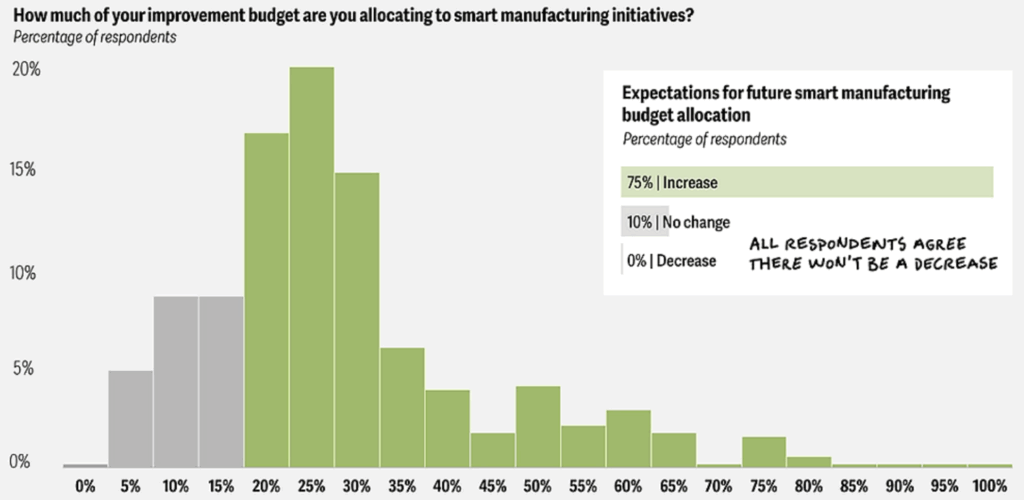
The missing link is often document intelligence. CAD files, bill of materials, maintenance logs, these are the unstructured anchors that weigh down digital twins, predictive analytics, and supply chain optimization.
Most advanced IDP vendors are already piloting agentic orchestration in manufacturing, moving toward autonomous automation. In practice, this means IDP systems that can not only extract data but also trigger downstream workflows, verify compliance, and collaborate with AI agents to optimize production in real time.
Manufacturers that ignore this will find themselves outpaced by those who treat IDP as the enabler of end-to-end transformation, not just a cost-control mechanism.
Lessons from the Field: The AI Payback Clock
The data from Deloitte is powerful, but the most striking validation came from a roundtable I recently hosted at the SSON event in Houston. Executives from Phillips 66, Energy Transfer, LyondellBasell, Halliburton, Catalent, and Cemex joined me for a candid conversation about AI-readiness in document pipelines and what it really takes to achieve payback.
The consensus was clear: the AI Payback Clock doesn’t start when you buy a new model — it starts when you fund accuracy upstream. As one executive put it, “We’ve spent millions tuning AI models that couldn’t overcome garbage inputs.”
Across industries, participants validated the same challenge: a large majority of operational data is still locked in unstructured formats – engineering diagrams, maintenance logs, contracts, or handwritten records. A leader from the discussion shared, “Our teams still spend weeks extracting and validating data across PDFs and forms. Until that changes, no AI pilot is going to scale.”
The cost of inaction isn’t just inefficiency; it’s compliance risk and missed opportunities. Another executive summed it up: “Every hour we spend manually fixing documents is an hour we’re not innovating. Automating compliance and accuracy is the only way to stay audit-ready and competitive.”
Others described the cumulative drag of manual workarounds as “death by a thousand cuts.” Several leaders acknowledged that teams still re-key, reformat, and stitch files together for reporting and submissions, work that drains millions in productivity yet rarely shows up explicitly on a balance sheet.
The takeaway from Houston? Regardless of sector, the bottleneck is universal: unstructured documents slow down AI payback. Organizations that shift investment upstream, making accuracy a funded priority, can expect to see 3–5x ROI on AI outputs compared to those trying to fix problems downstream. Or as one participant put it: “Now we see IDP as the accelerator; every day we wait to fix our pipelines is a day we delay AI success.”

Watch on-demand IDP Myth Busting session led by Jason Jakob, Chief Architect Officer, Adlib, to uncover best practices to improve your LLM and RAG accuracy by cleaning your data pipelines upstream.
Leadership Imperatives for 2026
For executives, the implications are clear:
- Stop treating IDP as tactical. It is not just a better scanner. It is a strategic enabler of AI, compliance, and transformation.
- Invest upstream. Success with AI is not about tuning prompts downstream; it’s about cleaning inputs upstream. That is where ROI lives.
- Tie IDP to outcomes. Frame investments not as “automation projects” but as enablers of measurable business outcomes: faster approvals, reduced cycle times, higher compliance confidence, improved agility.
- Future-proof now. Agentic AI is not five years away, pilots are already underway. If your inputs aren’t AI-ready today, your enterprise will not be able to scale tomorrow.

Join Adlib Software and West Point Technologies for “AI Document-First: RAG in Regulated Industries,” a live session on November 5, 2025, revealing how leaders in insurance, life sciences, manufacturing, and energy are transforming unstructured content into trusted, AI-ready data that fuels compliant, high-ROI GenAI.
Prioritize Upstream Accuracy in 2026
The story of IDP is the story of enterprise AI itself: promise without preparation leads to disappointment. Findings from MIT, Deloitte, Gartner, and my conversations with industry leaders, all point to the same reality: enterprises that get their document house in order are the ones that will translate AI from hype into hard ROI.
As leaders, our job is not to chase every shiny new model or agent. Our job is to ensure that the foundation is solid. That foundation is IDP. It is the shift from capture to autonomous automation. It is the connective tissue of the AI-ready enterprise.
If 2024–2025 was about pilots, 2026 must be about scaling. Those who recognize this, and act, will define the next decade of digital transformation. Those who don’t will watch from the sidelines as competitors scale.
Ready to assess your own AI Payback Clock? Schedule an Executive AI-Readiness Session where we will uncover how your enterprise can unlock 3–5x ROI by fixing the inputs first.

About the Author
Chris Huff is a growth-oriented CEO with a background in intelligent automation, enterprise transformation, and digital strategy. Prior to joining Adlib, he served as Chief Strategy Officer at Kofax, where he helped reposition the company into a market leader in intelligent automation. He brings deep experience from previous roles at Deloitte and the U.S. federal government, and is passionate about unlocking the full value of enterprise data through AI-powered innovation.
Click here to find more news from Adlib.

📨Get IDP industry news, distilled into 5 minutes or less, once a week. Delivered straight to your inbox ↓