

Curious about what keeps experts, CEOs and other decision-makers in the Intelligent Document Processing (IDP) space on their toes? Get food for thought on IDP-related topics from the industry’s leading minds.
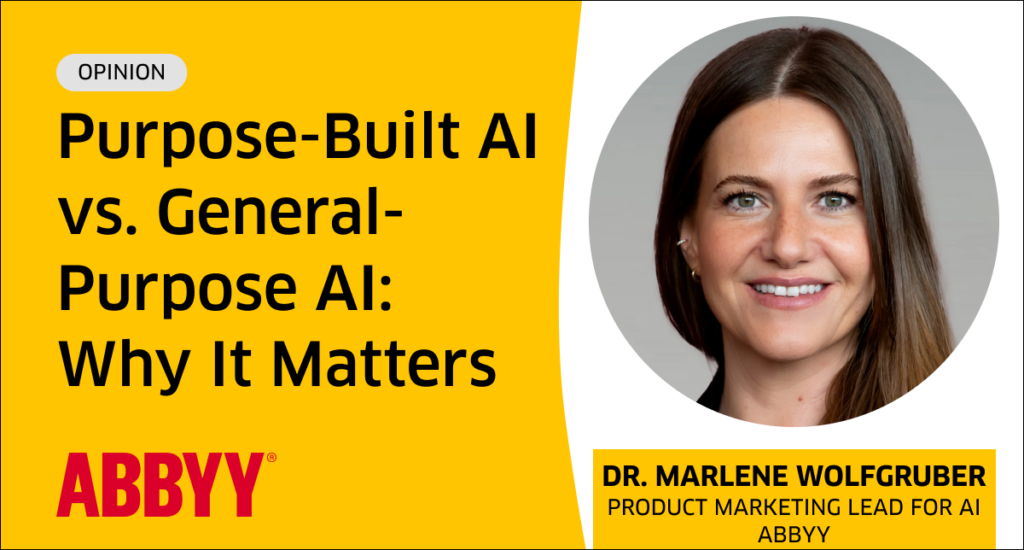
In this opinion piece, Dr. Marlene Wolfgruber, Product Marketing Lead for AI at Intelligent Document Processing (IDP) vendor ABBYY, explains that unstructured data makes documents the “dark matter” of business – and what organizations must do to turn this document dark matter into a business asset
As organizations evolve, so do the challenges of managing documents. For more than 5,000 years, documents have been central to preserving and sharing information. Today, however, enterprises face a new dilemma: information overload. Statista estimates that over 400 million terabytes of data are created every day, much of it unstructured or buried in documents, emails, PDFs, contracts, and other files. Gartner reports that 70-90% of this data is unstructured—making documents the “dark matter” of modern business: pervasive, yet largely untapped.
Documents Redefined
The concept of what qualifies as a document keeps expanding. From printed pages and email threads to meeting transcripts and chat channels, the flood of unstructured content continues. Despite digital advancements, industry analysts estimate that tens of trillions of A4 pages are printed globally each year, and faxing remains relevant—particularly in healthcare for its trusted security.
Responding to Complexity with Automation
We have witnessed multiple waves of document automation—from OCR in the 1970s to data capture, then RPA, and now Intelligent Document Processing (IDP). Each innovation has increased our ability to manage complexity, but none have eliminated previous approaches; they build on each other.
Now, large language models (LLMs) and generative AI have arrived, transforming our ability to interpret variable documents. LLMs allow systems to extract intent and content from freeform text, adapting to customer preferences and communication styles. This flexibility is a leap forward, but it introduces new concerns around reliability and accuracy. The latest evolution, agentic AI, promises to take this further by enabling autonomous systems that can execute multi-step tasks and make decisions without human intervention.
The Hybrid Approach: Balancing Power and Precision
Enterprises can’t afford to rely solely on generative AI. A purpose built, hybrid approach combines Document AI with LLMs to deliver both flexibility and critical safeguards. Like onboarding new employees, AI must be monitored, measured, and trusted gradually, especially in crucial workflows impacting customers or compliance.
Process First, Technology Second
Implementing AI should start with analyzing and optimizing the underlying process. Automating a flawed workflow only accelerates inefficiency. Sometimes the simplest solution—a script or regular expression—will outperform expensive, resource-intensive models. Leaders should focus on outcomes, not hype.
With AI agents and automation increasingly augmenting human effort, forward-looking organizations move past personal productivity gains and toward true process transformation: integrated ecosystems that support decision-making and unlock new business value.
Human Judgment Remains Essential
Critical thinking and human oversight remain central to this evolution. The most successful teams will know when to apply automation and when to involve human expertise. The goal isn’t replacement, but empowerment—using technology to free talent from repetitive work, so they can focus on strategic, competitive tasks.
Key Guidance:
- Avoid AI “washing”: Focus on solutions built for real business problems.
- Audit and optimize processes before automating.
- Insist on reliability—build guardrails and validate outcomes.
- See automation as a way to empower teams, not cut headcount.
Organizations that achieve the right balance between innovative technology and human insight will set the benchmark—turning document “dark matter” into a powerful business asset.

About the Author
Dr. Marlene Wolfgruber is the Product Marketing Lead for AI at ABBYY, bringing over 10 years of leadership experience in product management and marketing. She has deep knowledge in a wide range of topics within the intelligent automation industry, and regularly shares her expertise as an expert in AI and language technologies. In her previous roles, Wolfgruber led efforts to revolutionize AI-powered spend management and empowered businesses to build autonomous assistants with generative AI. Wolfgruber holds a Ph.D. in computational linguistics from Ludwig Maximilian University of Munich, and enjoys reading, exercising, cooking, and spending time with her two children.
To find more news from ABBYY, click here.
You may also like:
Purpose-Built AI vs. General-Purpose AI: Why It Matters
📨Get IDP industry news, distilled into 5 minutes or less, once a week. Delivered straight to your inbox ↓